
February Union Meeting Cancelled
Attention All Members:
Due to the ongoing provincial government’s COVID-19 state of emergency and stay-at-home order, be advised that the Wednesday, February 10th union meeting is cancelled.
Attention All Members:
Due to the ongoing provincial government’s COVID-19 state of emergency and stay-at-home order, be advised that the Wednesday, February 10th union meeting is cancelled.
The following article, submitted by International Representative Richard MacIntosh, was posted in the Edmonton Journal on January 22, 2021.
Investment in green technology will be critical, Richard MacIntosh writes.
When it comes to Canada’s natural resources, I can almost chant the numbers: 909 resource communities, 1.9 million jobs, $86 billion in investment.
Canada is No. 1 in the world for producing potash, No. 1 for canola, No. 2 for uranium, No. 5 for gold, No. 10 for copper. And No. 3 in the world for the area of forests and for oil reserves.
We now need all our resources to play their role in Canada’s recovery from the pandemic slump, and in Alberta and other provinces where resources underpin the economy. Investments in innovation and technology to support natural-resource development for the energy industry are vital, and create a win-win story for people and the environment.
Governments need to support such initiatives, which enable us to be greener when we extract, process, export and use energy resources. We rank No. 2 on the Global Clean-tech Innovation Index and have made real progress in tackling greenhouse-gas emissions from the oilsands and the oil and gas industry. But there’s more to be done.
We need to take a good look, for example, at the opportunities hydrogen can bring — in employment, wages and tax base — along with its zero emissions when used as a fuel.
Around the world, there are more than 1,800 LNG-fuelled electricity plants in various stages of construction. There is room to convert these to hydrogen, with small changes to the fuel-delivery system. I am a boilermaker, and I know. Canada can provide LNG, yes; but we can also provide hydrogen.
We also need to step up carbon-capture technology, which can decrease Canada’s carbon leakage, and at the same time create employment opportunities.
Look at three carbon-capture projects we have done in Canada: Boundary Dam in Saskatchewan, Shell Quest in Alberta, and the NWR Sturgeon refinery, also in Alberta. They created 6,121 total jobs, $1.6 billion in wages and benefits and generated $2.7 billion in GDP across Canada.
A Canadian white paper on large-scale carbon capture proposes a refundable capital tax credit provided in advance of construction of carbon-capture facilities, a tax credit focused on expenditures during the study and design phase of a project, and a production tax credit, similar to that of the 45Q incentive in the United States, to address competitiveness issues. Can we move on these?
And let’s consider some common sense in efficiencies: Why did we have to send 450,000 barrels of Alberta oil by tanker through the Panama Canal to New Brunswick, a journey of 12,000 kilometres in total? Because we don’t have pipeline capacity to do it.
Canada needs to support our own industries before we support the industries of other countries. We should build a pipeline across the country to deliver our oil to Canadians. And we can build a power line so Quebec can export its hydroelectricity.
As a union guy, I have to plead with governments to bring unions into the discussion about the future. They understand resource development and economics.
What does labour want to see from governments? Ensure job creation:
There’s a prescription for economic recovery and the economic future.
Richard MacIntosh is an international representative for the International Brotherhood of Boilermakers Canada and serves as the Boilermakers international assistant director of climate-change policy solutions. The union is also an adviser to the Task Force for Real Jobs, Real Recovery.
Dear Brothers and Sisters,
IMPORTANT – PLEASE TAKE THE TIME TO REVIEW AND SIGN THIS PETITION!
The Sarnia Building Trades and the Sarnia-Lambton’s Labour Unions have launched a petition “Canadians: Stop Michigan from closing Enbridge Line 5 Pipeline”.
The shutdown of this pipeline may jeopardize work opportunities for all trades including Boilermakers in the Sarnia region. That is why I am asking you to read the information provided in the links and then please consider signing the petition. The goal is to reach 100,000 signatures.
Links:
You can read further and then sign the petition here:
https://www.change.org/p/canadians-stop-michigan-from-closing-enbridge-line-5-pipeline
I thank you for your assistance in supporting this very important endeavor on behalf of all Boilermakers.
Fraternally yours,
ROY GRILLS
Business Manager / Secretary Treasurer
Boilermakers Local 128
To read the Fall/Winter 2020 edition of the Boilermaker Local 128 News Vessel, please login to the national Members website and select “Lodges” in the main menu then the “Local 128” tab.
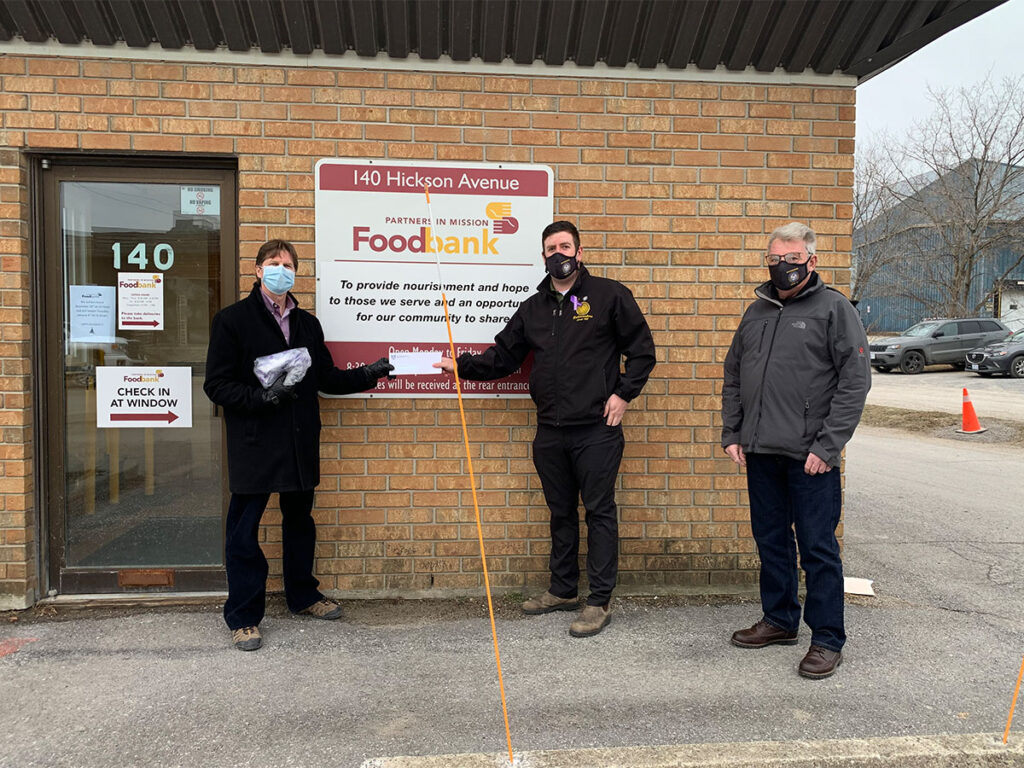
The need to support food banks is greater than ever this year. The Pandemic has affected many individuals and Boilermakers Local 128 in Ontario has responded in Purple Fashion. The Executive Board and Business Manager Roy Grills with the approval of the members have made 6 donations of $5000 each to food banks in Ontario. Food banks in Thunder Bay, Sault Ste. Marie, Sudbury, Hamilton, Kingston, and Sarnia have all received $5000. The total donation of $30 000 will help assist those in need over the holiday season. The generosity and kindness of the Boilermakers will hopefully bring some relief and happiness during the holiday season.
Merry Christmas.



To be held in Kincardine, ON
December 8th & 9th
This is a two full-days of training for active members interested in becoming a Steward or anyone who would like a refresher.
SEATING SPACE IS LIMITED!!
You must register by emailing
Stirling Munn or Tom MacNeil.
Details will be given regarding start time and location once registered.
Stirling Munn:
or
Tom MacNeil:
Please see the following communication from Business Manager Roy Grills regarding the November Union Meeting.
National Training Trust Fund (NTTF) recognizes Grant Jacobs’ years of service with the Boilermakers. Read more by clicking here (PDF).
Local 128 Membership:
Due to the uptick of COVID-19 cases and the ongoing government health agencies recommendations, until further notice all Local 128 monthly union meetings will be cancelled until further notice.
Please be advised that due to the COVID-19 Pandemic the September 9th Monthly Union Meeting has been cancelled.
 Copyright © 2022 International Brotherhood of Boilermakers. All rights reserved.